
The Balcony, the Dance Floor, and the Rubber Band
How Leaders, Teachers Unions, and Model Schools are Shaping the Future of Learning

A recent 24 hours back in my native Albany, New York, was a deep dive into the forces shaping the educational landscape across the Empire State and an informative window into the tensions at play when content and credit accumulation for high school graduation is shifted towards competency and skills acquisition.
Changing the System: Advice from Educational Architects
My trip began with the honor of meeting New York State Education Department (NYSED) Commissioner Betty Rosa, a career educator whose journey from paraprofessional to State Commissioner makes her an inspirational educational powerhouse. Our wide-ranging conversation, facilitated by Jim Baldwin—former Superintendent, Chief of Staff, college president, and co-creator of Tech Valley High School—focused on how to get from where New York State is today to the competency- and skills-based goals envisioned by NY Inspires and its accompanying Portrait of a Graduate.
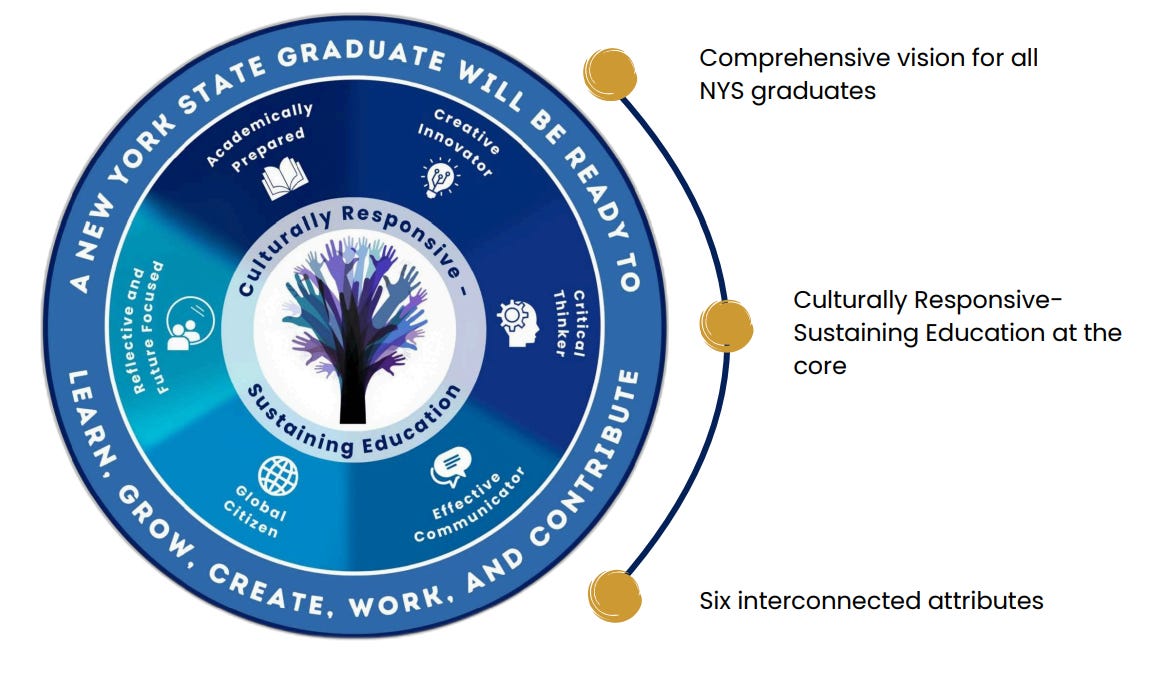
With Commissioner Rosa and Jim’s deep background in driving state-level reform and institutional leadership, I had to ask,
“From a leader’s perspective, what does it take to effect real and lasting change?”
Jim Baldwin on the “Balcony View”
When working toward a vision, Jim spoke about the necessity of putting change into motion ‘on the dance floor’, and then stepping up to the ‘balcony’ to observe. Jim’s advice, gleaned from the Adaptive Leadership framework, asks leaders to mobilize people towards an envisioned goal, but then intentionally stepping back to identify patterns and group dynamics before adjusting as (and if) necessary.
Commissioner Rosa on “Being a Rubber Band”:
Commissioner Rosa complemented Jim’s approach to affect change by suggesting that leaders should think of their work and guidance as akin to a rubber band—stretching the system with purpose towards a vision. Commissioner Rosa’s advice, rooted in Peter Senge’s concept of “Holding Creative Tension,” suggests that leaders keep the tension caused by a visionary change present but steady—stretching just enough to generate some movement toward the goal, but constantly checking to ensure the whole system or structure doesn’t snap under the strain.
Reflecting on these combined leadership frameworks, I could easily see how what I often did in the classroom – deliver a lesson, then step back to watch and adjust as students worked – was not only a tangible example of leadership in action, but a credible approach to accomplishing a common goal. And while I rarely thought about how the impact the state (or city) education department may (or may not) have been having on the front lines of my classroom, it is encouraging for me to know that the same general approach to leadership I used as a teacher is being paralleled by those guiding the entire cruise liner that is the state education system towards NY Inspires.
The Model in the Middle: Tech Valley High
The next day of my visit brought me face to face with a learning environment that embodies NY Inspires: Tech Valley High School. Co-founded by Jim Baldwin during his tenure as superintendent at Questar III BOCES, an organization that provides a variety of cooperative services to school districts across a region.
The small public high school (population ~140 students) that is Tech Valley is squeezed into the ever-expanding campus of SUNY Albany’s Nanotech facility, an inspirational embodiment of the region’s burgeoning tech-forward economy.
Tech Valley’s educational model is shaped by three core principles—innovation, authenticity, and student-centered learning—and draws on the New Tech Network’s Project-Based Learning (PBL) approach. During my tour of the school, I saw that Tech Valley is collaborative, authentic, and driven to help students develop real-world competencies and skills (the same traits NY’s Portrait of a Graduate seeks to uplift).
Student Change as Proof of Concept:
Nowhere was the success of this model more evident than in my student tour guides. As they guided me through the halls, they spoke to Tech Valley’s ability and the learning environment it fosters, making it a transformative educational space. Both guides described entering Tech Valley as shy, introverted 9th-grade first-years, hesitant to speak up or advocate for themselves. Now, as juniors, they were brimming with confidence, leading adults through their school with poise and pride.
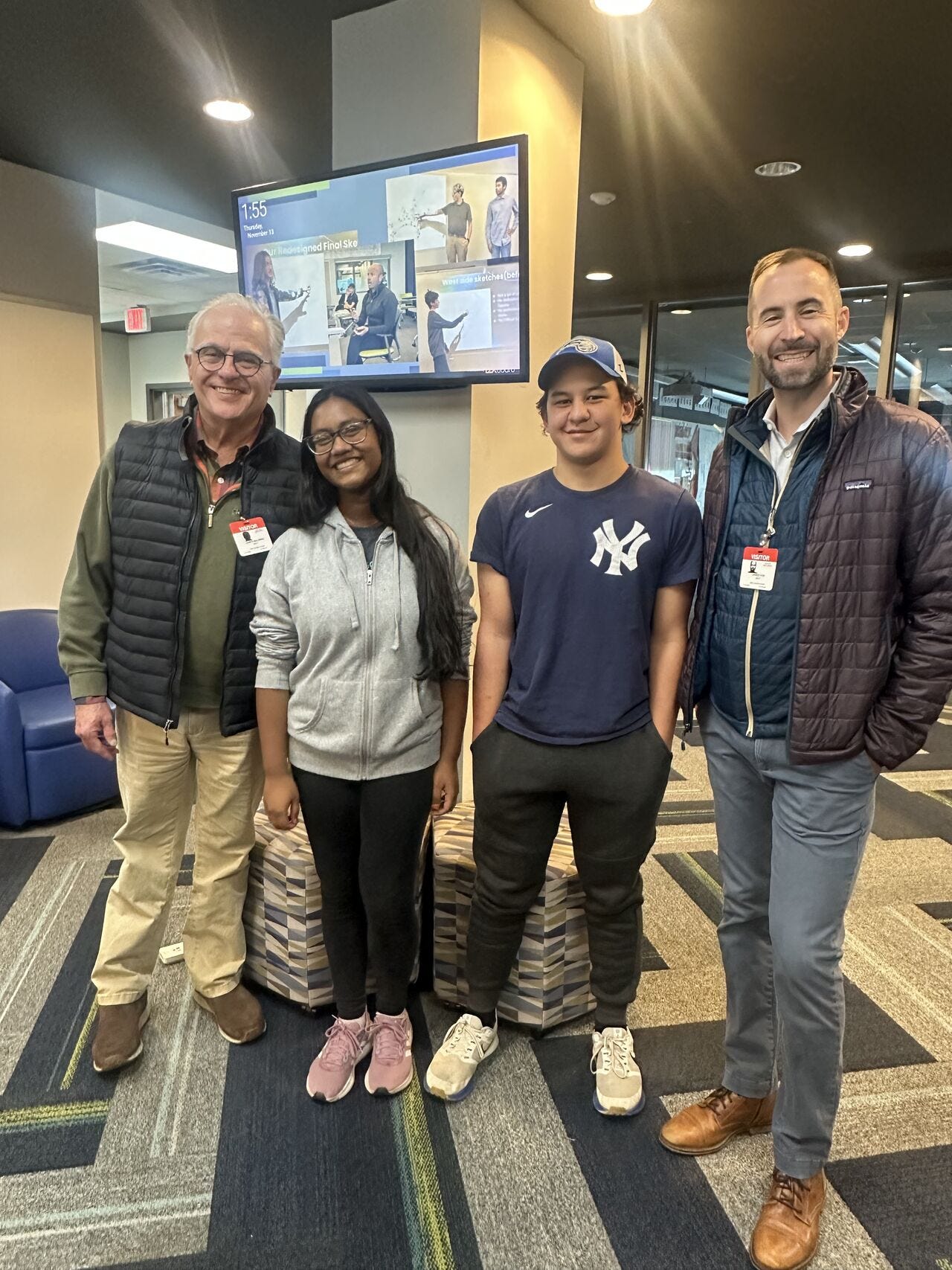
Additionally, Principal Amy Hawrylchak shared quantitative data from NWEA’s MAP testing, demonstrating that Tech Valley students, contrary to the expected trend of score flattening among most high schoolers, showed measurable growth. This data from schools built with project-based pedagogies and competency and skill acquisition attainment in mind may help address critics’ concerns about a perceived lack of rigor resulting from this approach and encourage more schools to adopt similar educational models.
In my view, Tech Valley, shaped by being immersed in creating and enacting project-based ‘learning by doing’ curriculum, is what the future of school should look like. Yet, its small size due to a plethora of political constraints (a topic worthy of its own lengthy post) serves as a poignant reminder that, despite its success, the pace of NY Inspires and other Portrait of a Graduate initiatives will often be hindered by the larger educational (and political) system it operates within.
That is, unless there is a concerted and collective mobilization of support across a variety of stakeholders (teachers, perhaps the most important among them).
The Politics of Pace: Administrators, Unions, & The Rank and File
After touring Tech Valley, I met with Peter Applebee, Director of Policy and Program Development at NYSUT (New York State United Teachers) headquarters, to discuss ways I could support NY Inspires’ teacher-training initiatives. During our wide-ranging conversation from the role of Teacher Centers in supporting front-line educators, to declining enrollment and birth rates in specific locales across the state, my main takeaway from our conversation was a better understanding of another tension playing out on ‘the dance floor’.
That tension, primarily driven by the Union (and my former colleagues’) concern about the pace at which NY Inspires will be adopted, is a worthy one. And while NYSUT is generally on board with what the state education department is trying to accomplish, they are rightly wary of top-down initiatives following the high-stakes testing and accountability initiatives of decades past.
Indeed, the call to reimagine education—especially at the high school level—that NY Inspires advocates for will not happen overnight, even as current workforce shifts, driven by changing demographics and AI-infused technology, demand it.
Instead, it will require sustained, collaborative efforts from a wide range of stakeholders, including educators in schools and higher education institutions that train future teachers, and education leaders and policymakers outside the classroom, working together towards a shared vision.
So, while my experience as a teacher relies heavily on what it takes to effect change at the classroom level, I nonetheless feel the story I share here, as well as those I detail in Learning Environment about the project-based, deeper-learning pedagogy I gradually embraced, can serve as lesson for how to accomplish big things by starting small and galvanizing support from a multitude of stakeholders–being sure to celebrate and replicate success.
In this manner, the ‘rubber band’ can be slowly stretched toward a lofty vision as long as we also remember to pause, observe, and adjust from the ‘balcony’ for how changes are playing out on the ‘dance floor.’
With all of Learning Environment’s launch-phase events now complete, my work is shifting from promotion to reengagement.
Before completely moving on, however, I’d like to share that my last launch event entailed having the joyous honor of appearing on WNYC’s The Brian Lehrer Show.
If you missed it, have a listen below. Enjoy!
This is some of the best thinking I've seen on actualy implementing education reform. The "rubber band" metaphor captures something most reformers miss, which is that tension between vision and reality isn't a problem to elimnate but a dynamic to mananage. What struck me is how NYSUT's pacing concerns, which could easily read as obstruction, might actually be the critical feedback loop that keeps these reforms from snapping under their own ambition.